
In mid-November 2025, the Zuni Mountains Collaborative held a meeting of the Monitoring Subgroup to review the past year of ecological monitoring in the Zuni Mountains landscape. The meeting featured three partner presentations and discussion of findings in the context of forest and watershed management. As we look forward to another year of adaptive management in the Zuni Mountains and the monitoring which informs our management strategies, we invite you to pause and reflect on what we collectively learned from our work in 2025. Please read on to review the presentations on the Bluewater Lake Christmas bird count, watershed restoration, and invasive plants, and additional information on the Mexican Spotted Owl and Collaborative Monitoring.
To access a recording of November’s virtual meeting, click here. If you have any trouble accessing the recording, please email mateo@forestguild.org. Copies of John and Mateo’s slides may be viewed by clicking on the images below.
Click the image to view John’s presentation slides.
John Trochet, ornithologist and retired doctor, presented on the annual Bluewater Lake Christmas Bird Count conducted in December 2024. Optimum conditions and the participation of skilled birders made this edition of the Christmas Count a smashing success, with total counts of 5,829 individual birds and 101 species, a record for the Bluewater site.
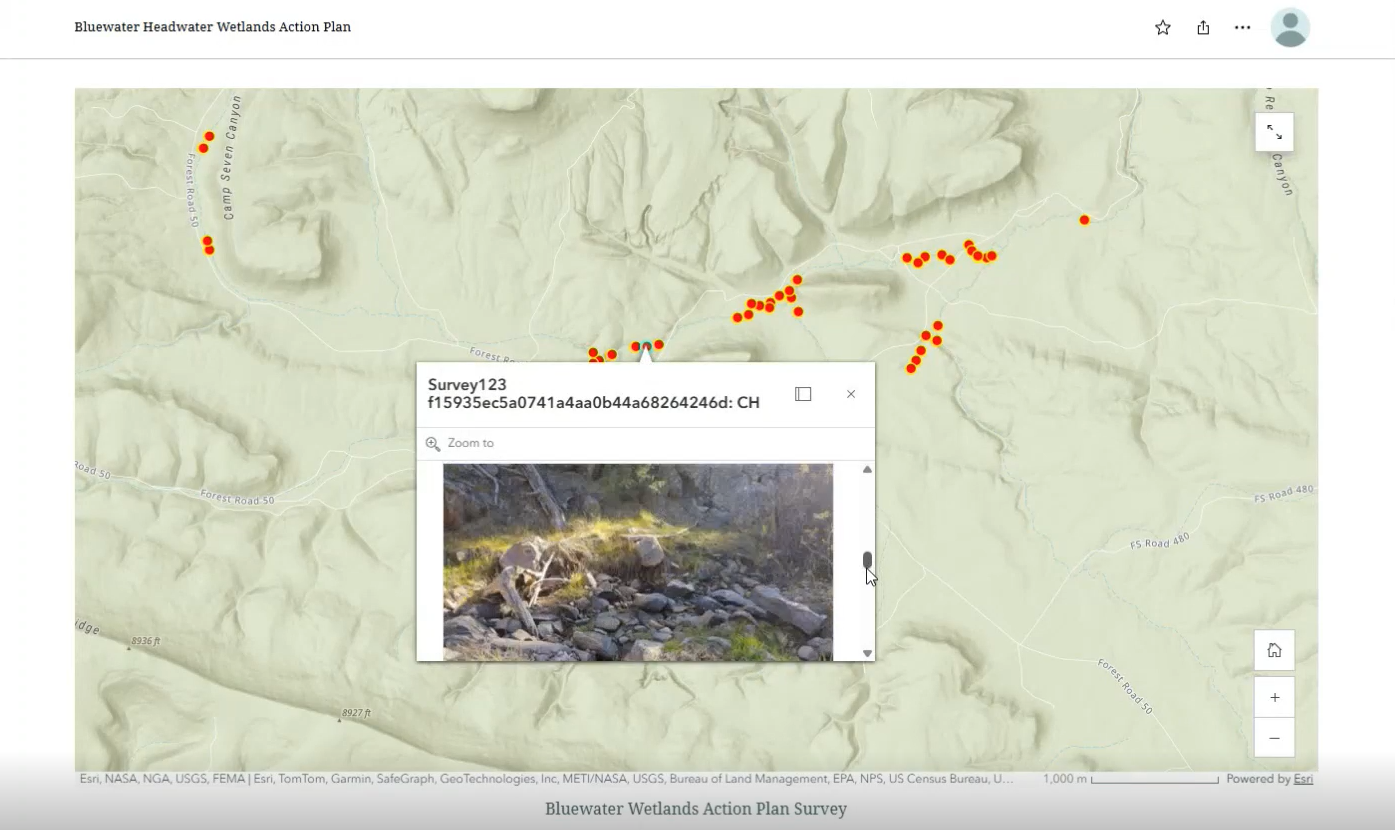
Rich Schrader, Director of River Source, presented monitoring information from a draft Watershed Action Plan that River Source is preparing for the upper portion of Bluewater Creek, which includes Shush Kin Fen and associated wetlands.
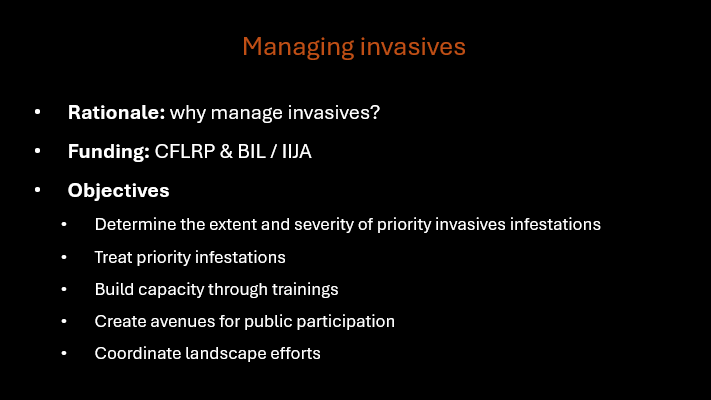
Click the image to view Mateo’s presentation slides.
Mateo Pomilia, Program Manager at the Forest Stewards Guild, updated the group on invasive plant monitoring that the Guild initiated in 2024. Species inventoried in 2025 included saltcedar, Russian olive, Siberian elm, musk thistle, and bull thistle. The presence of a biological control agent for musk thistle - the musk thistle weevil (Rhinocyllus conicus) - was detected in two areas, displaying significant damage to target plants.
Mexican spotted owl (MSO): Due to the government shutdown, which was ongoing at the time of the meeting, U.S. Forest Service (USFS) staff were unable to present. However, Andrea Chavez, Cibola NF Wildlife Program Manager, reported that MSO surveys continued in the Zuni Mountains in 2025.
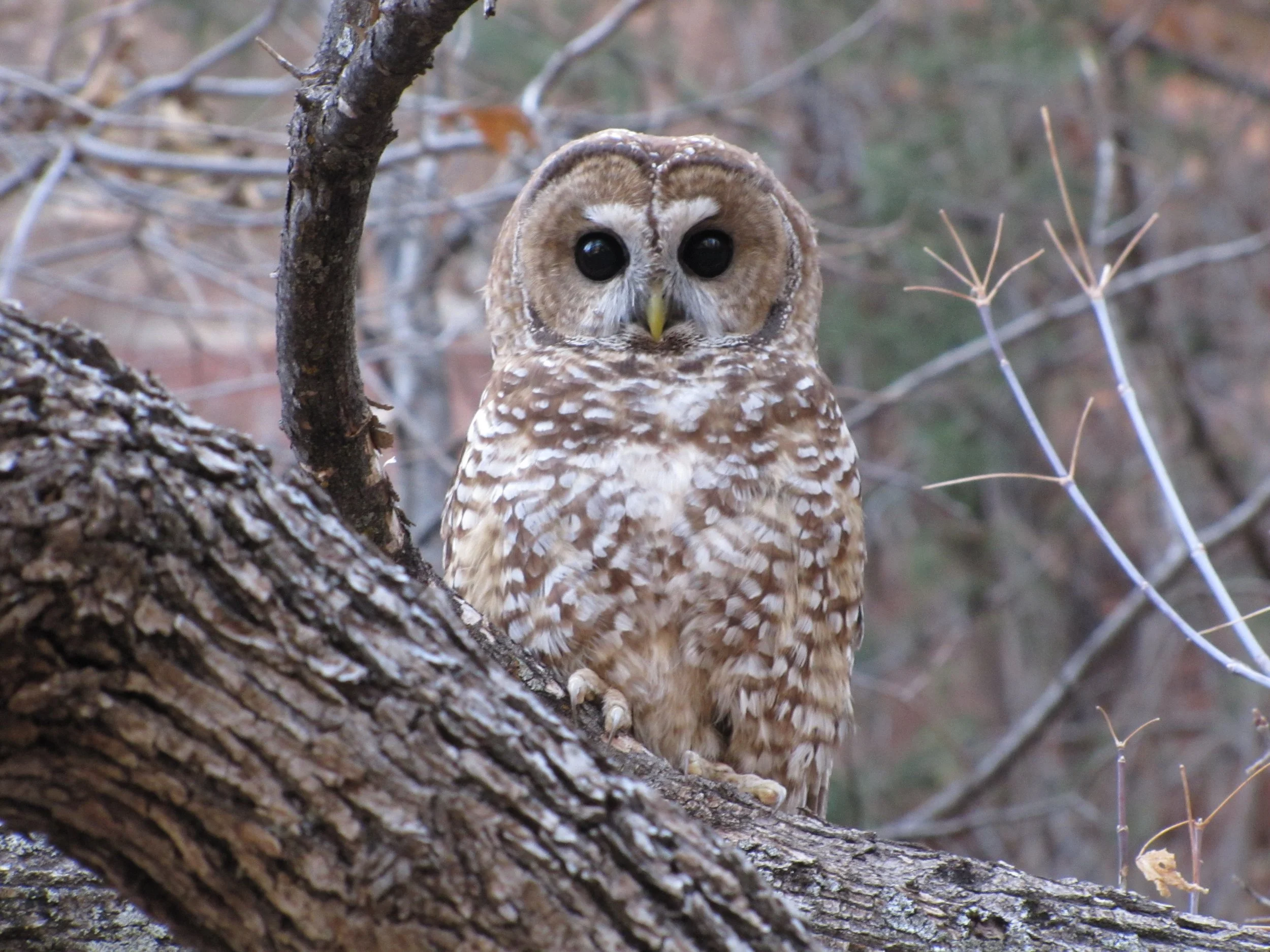
Mexican spotted owl, Shaula Hedwall/USFWS, Public Domain, https://www.fws.gov/media/mexican-spotted-owl
While data show an increase in the number of MSO Protected Activity Centers from 1988 – 2025, this trend is most likely due to an increase in the number of surveys conducted - which led to the discovery of new nesting pairs - rather than an increase in the actual number of owls. Inconsistent sampling across space and time since surveys began in 1988 makes it difficult to confidently interpret MSO occupancy trends in the Zuni Mountains.
Collaboration Monitoring: Total participation in Zuni Mountains Collaborative meetings and events in 2025 included 81 individuals representing 31 organizations from eight sectors, including: federal agencies, state agencies, Tribal entities, nonprofits, local businesses, government, higher education, and local residents.
Zuni Mountains CFLRP Multiparty Monitoring Plan: In early August 2025, a full draft of the Zuni Mountains CFLRP Multiparty Monitoring Plan was circulated to the Zuni Mountains Monitoring Subgroup via email. On August 25, an in-person meeting was held at the USFS Supervisor’s Office in Albuquerque to discuss and make edits to the Plan. An updated version of the Zuni Mountains CFLRP Multiparty Monitoring Plan can be accessed here.